Creating a safe workplace and I mean a workplace that's genuinely safe, not just one that's checked all the right boxes on the compliance checklist requires a whole lot more than just ticking the right boxes. If you're operating in a high risk industry like construction, manufacturing, offshore oil and gas, utilities, or renewable energy you need a clear plan in place to identify the hazards, implement controls and measures, track how well things are working, and then keep pushing to make things even better.
That's where PDCA in Safety comes in, it's a way of doing things that makes a real difference. The Plan Do Check Act (PDCA) in Safety Management approach is about using a structured method to really get a handle on health and safety one that involves constantly evaluating and upgrading things as you go along. So instead of just reacting to problems after they happen, the PDCA cycle encourages organisations to take a proactive approach to risk, build a strong safety culture, and just generally do things better.
Whether you're putting a new ISO 45001 aligned Safety Management System (SMS) in place or just looking to give your existing HSE processes a bit of a shake up, getting to grips with the PDCA Cycle in Safety Management System will help you reduce workplace risks, keep on top of compliance, and drive long term business success.
What is PDCA in Safety?
PDCA in Safety is a way of getting better at health and safety all the time. Its also known as the Plan Do Check Act cycle and basically lets organisations have a regular go at managing workplace risks, making sure all the operational controls are working properly and also keeping track of whether their safety ideas are actually working.
Originally developed for quality control because who doesnt want a decent cup of coffee PDCA cycle has now become a vital part of how organisations do Health, Safety & Environment (HSE) work. You see it all the time in things like ISO 45001, ISO 9001, and ISO 14001 where organisations use it as the base for all their management systems.
Rather than just doing a one off safety thing and then calling it a day, the PDCA Cycle in Health and Safety is all about looking at how you did just now, seeing what you can learn from any accidents and inspections, then sorting out any problems you found, and also keeping an ear to the ground for anything that might change in the way your operation works.
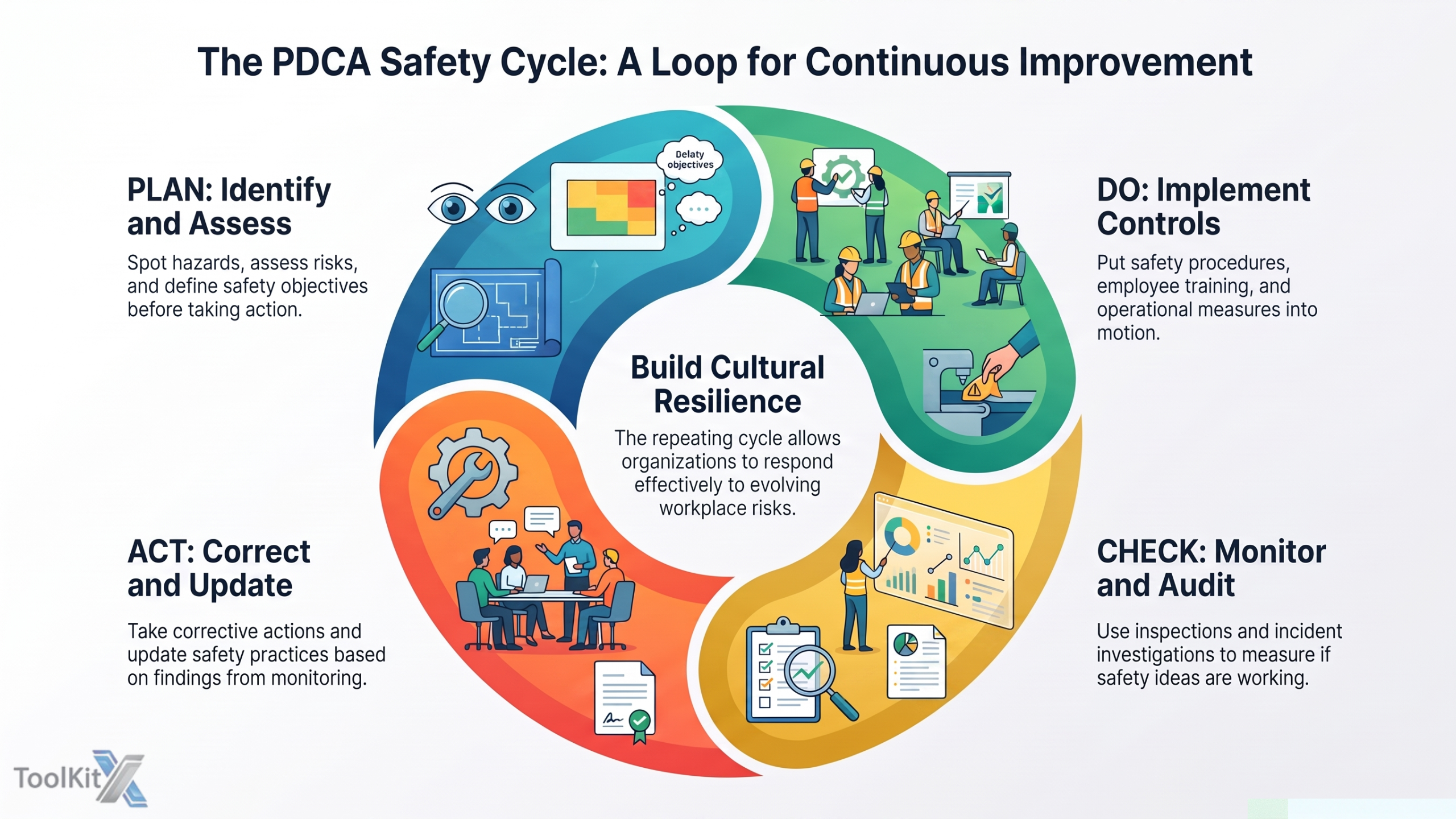
At its core, the framework follows four interconnected stages:
- Plan: Identify hazards, assess risks, and define safety objectives.
- Do: Implement controls, procedures, training, and operational measures.
- Check: Monitor performance through inspections, audits, incident investigations, and safety metrics.
- Act: Take corrective actions, improve processes, and update safety practices based on findings.
Because the cycle is continuous, organizations can respond more effectively to evolving risks while building a stronger and more resilient safety culture.
Why is the PDCA Cycle Important in Safety Management?
The Importance of PDCA in Safety goes way beyond just ticking boxes to meet regulations. What it really gives you is a framework that lets you continually build on workplace safety while keeping the rest of your operation running smoothly and as a bonus, giving you a bit of extra resilience in the process.
In many industries, new equipment, changing work environments, contractor activities, and evolving regulations introduce new hazards. Without a systematic improvement process, safety programs can become outdated, allowing risks to go unnoticed.
Implementing PDCA in Safety Management helps organizations:
- Proactively identify workplace hazards before incidents occur.
- Strengthen risk assessment and hazard control processes.
- Improve compliance with OSHA regulations and ISO 45001 requirements.
- Standardize safety procedures across multiple sites and departments.
- Enhance employee participation and safety awareness.
- Reduce recurring incidents through effective corrective and preventive actions (CAPA).
- Support continuous learning and organizational improvement.
For instance, in a manufacturing facility you might notice that people are getting a few more minor hand injuries when they're doing routine equipment maintenance. The instinct might be to just sort each incident out individually, but the PDCA way is to drill down into what's causing them, have a good look at how you're doing maintenance, improve the training, sort out your work instructions and then keep an eye on future performance to make sure the changes you make are actually working.
This proactive mindset shifts organizations from reacting to incidents to preventing them altogether.
Four Stages of PDCA in Safety
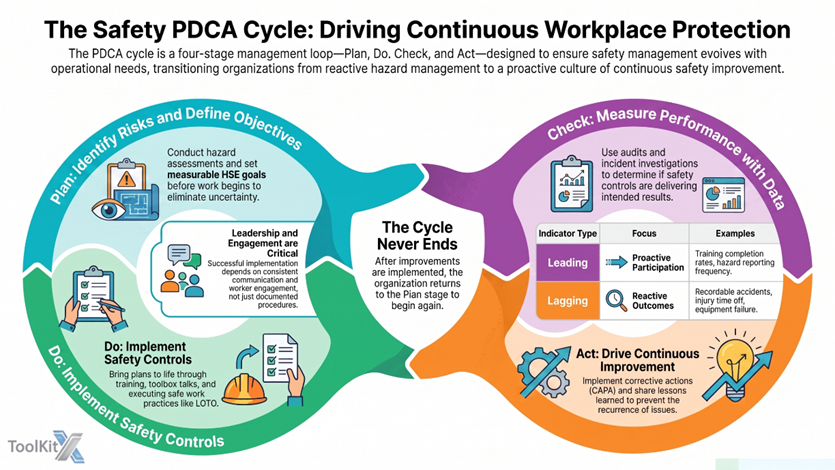
The Four Stages of PDCA work together as a continuous improvement loop. Each phase builds on the previous one, ensuring that safety management evolves alongside operational requirements.
-
Plan: Identify Risks and Define Safety Objectives
It's the planning phase that really sets the stage for a successful PDCA Cycle in Safety Management System. What it's all about is getting a solid grasp on the hazards lurking in your workplace, figuring out just how big of a risk they are and then determining what needs to be done to keep people, contractors, equipment, and the environment out of harm's way.
Typical planning activities include:
For instance, before beginning excavation work on a construction site, the project team may assess underground utilities, soil stability, traffic management requirements, and environmental conditions. Based on the findings, they develop safe work procedures, define permit requirements, and assign responsibilities before work begins.
By taking the time to do a thorough job of planning, you can eliminate a lot of uncertainty and ensure that the safety measures are put in place right from the start, rather than after something has gone wrong.
-
Do: Implement Safety Controls
Once planning is complete, organizations move into implementation.
The Do Phase really brings all the planning and preparation to life by implementing safety procedures, engineering controls, training programs and operational processes in a way that just feels natural to day to day life.
Key activities include:
- Conducting toolbox talks
- Delivering employee and contractor training
- Issuing work permits
- Implementing lockout/tagout (LOTO) procedures
- Using appropriate personal protective equipment (PPE)
- Performing equipment inspections
- Following standard operating procedures (SOPs)
- Executing safe work practices
When it comes to an offshore maintenance project that involves working in cramped spaces, for example, during the implementation phase supervisors are going to check the results of the gas testing, make sure rescue plans are good to go, issue confined space permits, and do a pre job briefing with the whole team to make sure everyone knows what is expected of them before the work even starts.
Successful implementation depends not only on documented procedures but also on leadership commitment, worker engagement, and consistent communication across the organization.
-
Check: Measure Safety Performance
The Check phase evaluates whether implemented safety controls are delivering the intended results.
Rather than just assuming that procedures are working as they should, organisations start to collect data, take a close look at how things are going & spot areas where they can make things better.
Typical monitoring activities include:
- Workplace inspections
- Internal and external audits
- Safety observations
- Incident investigations
- Near miss reporting
- Compliance assessments
- KPI monitoring
- Management reviews
Leading indicators such as how many inspections are getting completed on time, how many staff are participating in safety training and how often people are reporting potential hazards, help give a good idea of how proactive a company is being about safety. On the other hand, lagging indicators like how many accidents happen that have to be recorded, time off work due to injury and how often the equipment fails these all help us work out how effective the safety programme actually is.
For instance, if regular inspections keep turning up the same problems with housekeeping in a warehouse and that's even though they've got procedures in place then you know the organisation needs to investigate what's going wrong. Is it because the staff just aren't being properly trained, or is it because supervisors aren't keeping an eye on things , or are the responsibilities a bit fuzzy or is the communication just not good enough?
Data driven decision making ensures that safety improvements are based on measurable evidence rather than assumptions.
-
Act: Drive Continuous Improvement
The final stage of the Plan Do Check Act cycle focuses on improving the management system based on findings from the evaluation phase.
When audits, inspections, incident investigations, or performance reviews identify weaknesses, organizations implement corrective and preventive actions to eliminate root causes and prevent recurrence.
Common improvement activities include:
- Updating risk assessments
- Revising safe work procedures
- Implementing CAPA
- Improving training programs
- Modifying engineering controls
- Updating emergency response plans
- Reviewing organizational objectives
- Sharing lessons learned across departments
Importantly, the Act phase does not signal the end of the process. Once improvements have been implemented, organizations return to the Plan stage and begin the cycle again using updated knowledge and improved controls.
This ongoing cycle creates a culture where learning, adaptation, and continuous improvement become part of everyday operations rather than isolated initiatives.
How the PDCA Cycle in Safety Management Works in Practice
Understanding the PDCA method for health & safety management is super valuable, but where it really shines is in how it plays out on a day to day basis.
Imagining a manufacturing facility that's been plagued by slip and fall incidents near the coolant dispensing area that's a pretty grim situation.
The safety team starts by trying to figure out what went wrong: they launch an investigation, pin down issues like leaky equipment, bad drainage, and a scatter of housekeeping practices as contributing hazards. From there, they quantify the risks, set some specific improvement goals, and start hammering out a plan of action.
As the Do phase kicks in, the maintenance crew gets to work on fixing leaky equipment, slapping in some anti slip flooring, tightening up the cleaning schedules, and making sure the employees are all up to speed.
Next, the supervisors go out there to see just how well all these improvements are holding up through regular inspections, some good old fashioned safety observations, looking at the trends in incidents, and checking in with the staff for their two cents.
And finally, the management team takes the lessons they've learned and actually does something about them by updating the SOPs, getting that valuable experience baked into the next round of training, and revising those risk assessments to stop a similar mess happening elsewhere in the facility.
Rather than just fixing one little incident, the organisation is actually using PDCA to strengthen its entire safety management system that's just about the ultimate definition of PDCA in Safety Management.
Benefits of the PDCA Cycle in Health and Safety
Implementing the PDCA cycle in Health & Safety is about doing more than just meeting regulatory requirements its all about having a clear plan to spot potential hazards before they become problems & to keep on improving safety processes as you go. With the right approach an organisation can really raise the bar on safety performance, help with compliance and keep on pushing the boundaries of what's possible.
Improves Workplace Safety
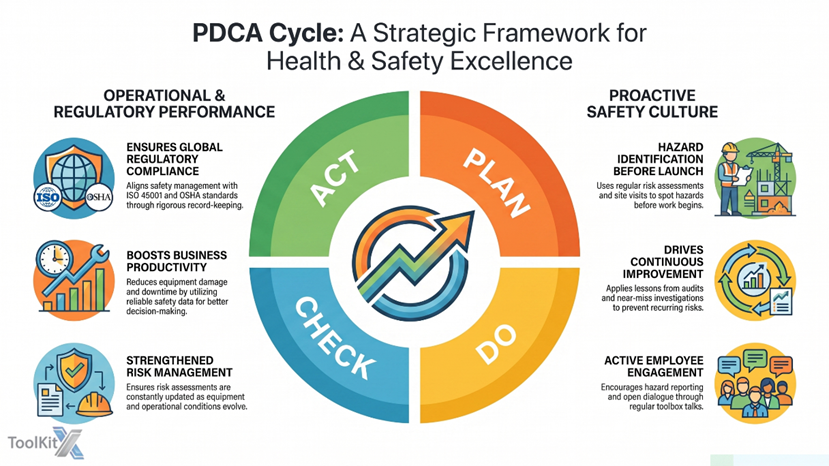
The PDCA cycle is brilliant for spotting hazards before a job even starts its all down to regular risk assessments, visits to see how things are going and keeping an ear to the ground for potential issues. By doing this on a regular basis, organisations can cut down on workplace incidents and make sure that things are safe.
Supports Regulatory Compliance
Using PDCA to manage Health & Safety really helps organisations stick to the rules set out in ISO 45001, OSHA and all the other health and safety regulations out there its all about keeping good records and getting ready for audits.
Strengthens Risk Management
The PDCA method for health & safety management ensures that risk assessments are regularly reviewed and updated as workplace conditions, equipment, and operational risks evolve.
Encourages Employee Engagement
The PDCA framework really encourages people to get involved its all about reporting hazards & near misses, doing regular toolbox talks and keeping an open dialogue so that everyone feels like their voice is being heard.
Drives Continuous Improvement
Plan Do Check Act (PDCA) in Safety Management uses all the lessons it learns from audits, inspections, investigations and near misses to make things better, avoid common risks and drive forward with safety performance
Improves Business Performance
Having a good safety program in place helps reduce downtime, cuts down on equipment damage, makes your organisation more productive and helps you make better decisions all because you've got more reliable safety data to work with.
Common Challenges When Implementing PDCA in Safety
Its no surprise that a PDCA Cycle in Safety Management only works with ongoing effort and a real commitment to leadership from the top. If you dont address these common pitfalls, they are sure to hold you back.
Treating PDCA as a One Time Project
The thing is PDCA is a continuous cycle of improvement, not some one shot initiative that you can tick off and forget about. It needs regular check ins to keep on top of changing workplace risks.
Focusing Only on Compliance
Youre probably aware that following the regulations is important but when it comes to PDCA in Safety Management, it's all about driving safety improvements and reducing risks day in, day out.
Weak Performance Monitoring
Without tracking all the right indicators both leading and lagging youll never have a clear picture of how your safety performance is shaping up, or where you might need to make some changes.
Incomplete Root Cause Analysis
Fixing the immediate problem is not the same as getting to the root cause of the issue. If you dont tackle the underlying causes, you can bet that the problems will just keep on coming back.
Limited Workforce Participation
When everyone from the frontline to the bosses to the contractors is properly involved in the safety management system, you get real communication, real accountability and a much stronger overall system for keeping people safe.
Best Practices for Applying PDCA in Safety Management
The organizations who manage to get PDCA working for them in Safety are the ones that stick to a set of tried and true best practices, consistently applied.
Base Decisions on Risk Assessments
Every new safety project should start with a proper look at what could go wrong, don't just guess at it. Then rank those potential problems in order of how serious they are. It's a simple rule, but one that gets ignored surprisingly often.
Monitor Leading and Lagging Indicators
Effective safety management combines proactive and reactive measurements.
Leading indicators may include:
- Completed inspections
- Safety observations
- Training completion
- Hazard reports
- Preventive maintenance activities
Lagging indicators may include:
- Recordable incidents
- Lost time injuries
- Property damage
- Environmental incidents
- Equipment failures
Monitoring both types of indicators provides a comprehensive understanding of safety performance.
Conduct Regular Audits and Inspections
Doing inspections regularly helps make sure that all those safety procedures are still working as planned, in day to day life. And having internal audits done means you get to find out if the documentation is up to scratch, if people are following the rules and if everything is running smoothly.
Document Lessons Learned
Every single time an incident happens, or an audit finds a problem, or you fix something that wasn't working right, you get to learn something new. And that's valuable knowledge that can prevent other departments from stumbling over the same problems later.
Conclusion:
In practice, platforms such as ToolKitX can really help by digitising HSE workflows and giving you a much clearer view of how your safety game is going plus they make it easier for teams to get on top of inspections, incidents, when you need to sort out problems and sort out those permits to work a lot more efficiently. To be clear, they dont replace the PDCA methodology so much as give each stage a bit more of a clue, some accountability & actually get you to rely on the data more..
So whats it gonna take to really beef up your safety management system? Have a think, then see how a digital HSE platform like ToolKitX could help tidy up the PDCA cycle for you, give you some real insight into whats going on operationally and help keep your organisation getting better and better at health & safety.