Workplaces in the construction, manufacturing, utilities and offshore industries are constantly dealing with hazardous situations. Heavy equipment, poisonous substances, dodgy electrical systems, people working at heights and shifting site conditions all create a continuous threat to people and equipment, and can lead to accidents, hold ups and safety problems if not kept under control.
This is why it's so vital to get to grips with the 5 steps to risk assessment. Having a clear, organised risk assessment process in place helps businesses pinpoint hazards, figure out the damage they could potentially cause, sort out practical controls and keep on looking for ways to improve workplace safety. And to be honest, it flips safety management from being a fire fighting exercise to a forward thinking one.
Whether you are conducting a construction risk assessment, preparing a manual handling risk assessment, performing a COSHH risk assessment, or reviewing a workplace fire risk assessment, the same five step framework applies. When implemented correctly, it becomes one of the most effective tools for preventing incidents and supporting long term operational excellence.
What Is a Risk Assessment?
A risk assessment is all about making a real effort to identify potential hazards, think about the possible risks, and putting in place the right measures to stop things going wrong. In simple terms, it's a way for organisations to figure out what could possibly go wrong, who might be affected if things do go wrong, and what steps they need to take to keep things under control.
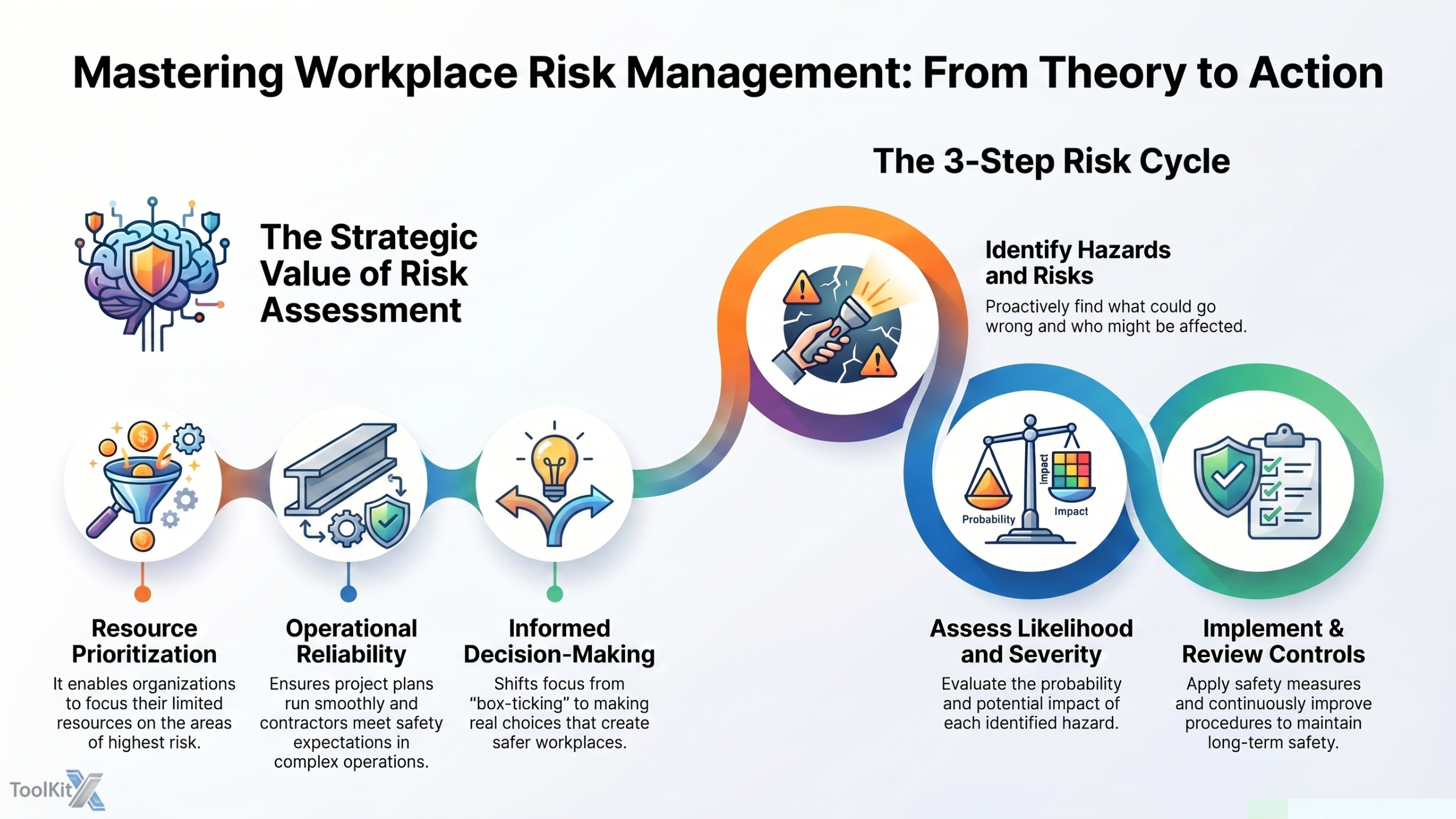
The whole point of doing a risk assessment is about more than just ticking boxes to prove you're doing what you're supposed to. It lets organisations make some real decisions, prioritise their resources better and actually create safer workplaces a much better outcome all round. And when you're dealing with complex operations, risk assessments become vital whether that's for straightforward day to day maintenance and keeping a close eye on safety, or for making sure that project plans run smoothly and you can trust that your contractors know what they're doing.
A risk assessment basically helps organisations to:
- Identify hazards and risks in the workplace
- Assess the likelihood and severity of harm
- Implement suitable control measures
- Review and continuously improve safety procedures
Why Are Risk Assessments Important?
Every Workplace Has Its Hazards, and the Goal is Not to Eliminate Every Last Risk But to Get a Handle on Them.
The benefits of risk assessment are both operational and strategic. On one hand, you reduce workplace injuries and get your downtime down to a minimum, which in turn helps with compliance and keeps your business running. On the other hand, by identifying potential problems before they become disasters, you get to make more informed decisions and just plain think ahead.
When it comes to building site risk assessments on construction sites, you're talking about things like excavations and heavy equipment that's in motion. In a factory setting, work equipment risk assessments can sometimes turn up things like busted machine guards or people being forced to carry around heavy stuff when they shouldn't be all potential for trouble that can be avoided with a little foresight. And when you're dealing with utility or offshore work, where even tiny mistakes can have huge consequences, risk assessments are key to keeping things running smoothly.
Simply put, risk assessments are necessary because prevention is always more effective and less costly than incident response.
Explore Our HSE Management Software @ https://toolkitx.com/campaign/hse/
Difference Between Hazard and Risk
One of the most common areas of confusion in health and safety is the difference between hazard and risk.
|
Hazard
|
Risk
|
|
Wet floor
|
Employee slips and suffers an injury
|
|
Exposed electrical cable
|
Worker receives an electric shock
|
|
Hazardous chemical
|
Employee experiences chemical exposure
|
A hazard is anything with the potential to cause harm, while a risk refers to the likelihood that harm will occur and the severity of its consequences. Understanding the difference between hazard and risk is fundamental to conducting an effective health and safety risk assessment.
The 5 Steps To Risk Assessment
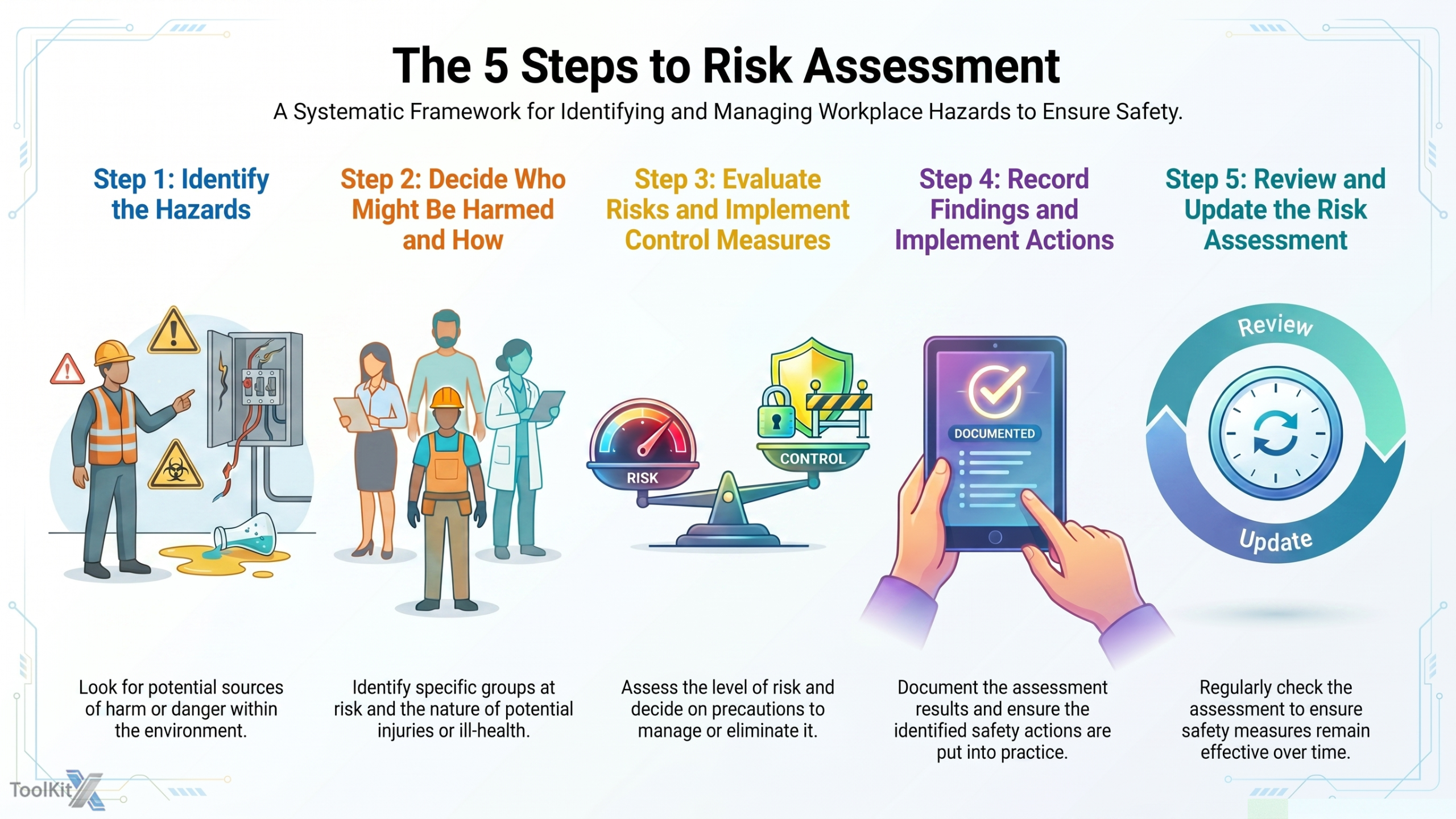
Step 1: Identify the Hazards
The first step of risk assessment is to identify hazards that could potentially cause harm.
These potential sources of trouble can come in all shapes and sizes we're talking physical, chemical, biological, ergonomic, and psychosocial hazards. You might find them lurking in the form of unguarded machinery, some not so friendly chemicals or some nasty old substances, a workplace that's just too darn noisy, or even a workstation that's just not designed right, not to mention a job that's just too stressful. And let's be honest, some things are just plain hazardous from an altitude.
For example, a construction site risk assessment may identify excavation hazards, moving vehicles, and temporary electrical installations. A manufacturing facility may identify machinery entanglement risks, manual handling activities, and chemical exposure requiring a COSHH risk assessment.
Hazard identification should involve workplace inspections, consultation with workers, incident reports, and previous risk assessment examples. Organisations should also consider potential hazards that may arise during maintenance activities, shutdowns, or emergency situations.
Step 2: Decide Who Might Be Harmed and How
Once you've identified potential hazards, the next step is figuring out who might be impacted and in what way.
Risk assessments shouldn't just focus on employees. People who might be exposed to workplace hazards include contractors, visitors, maintenance crews, and even the general public. And there are often certain groups that are more likely to be at risk like new hires, people who work alone, young workers or anyone who has to deal with high risk jobs.
For example, a risk assessment for working at heights might turn up different hazards for scaffolders, roofers and maintenance teams each of those groups has different risks and different needs when it comes to keeping them safe. Similarly with a work related stress risk assessment that might highlight different stress factors affecting supervisors versus operational staff.
Affected persons may include:
- Employees of the company
- Contractors coming in to do work
- Visitors to the building or site
- Maintenance and repair crews
- Anyone from the public who might be affected
Knowing who might get hurt helps your organisation target control measures exactly where they're needed and do it in a way that really works.
Step 3: Evaluate Risks and Implement Control Measures
The third step involves evaluating risks and determining appropriate control measures.
Many organisations turn to a 5x5 risk matrix or risk assessment matrix 5x5 to get a grip on their risk levels a pretty straightforward way to figure out how much trouble you might be in by weighing up the likelihood of something going wrong against the consequences if it does.
|
Likelihood
|
Severity
|
|
Risk Rating
|
|
Low
|
Minor injury
|
|
Low
|
|
Possible
|
Moderate injury
|
|
Medium
|
|
Likely
|
Major injury or fatality
|
|
High
|
This sort of risk assessment rating is pretty handy for organisations trying to decide where to focus their efforts and make sure they're putting their resources in the right places basically helping them prioritise what needs to be done.
When it comes to control measures, people often talk about following the hierarchy of risk control measures. The idea here is that getting rid of a hazard altogether is generally the best option, but if that's not possible then you might be looking at substituting it with something safer, implementing engineering controls, introducing admin controls, or as a last resort relying on personal protective equipment.
For example, when you're doing a working at height risk assessment, installing permanent guardrails is a much better bet than just relying on harnesses. Same goes for an electrical risk assessment you might be looking at isolation procedures, some form of engineering control and a permit to work system to keep exposure to a minimum.
Step 4: Record Findings and Implement Actions
A risk assessment should always be documented in a clear and accurate way.
A usual risk assessment form or to be honest, just a straightforward risk assessment sheet will include hazards that have been spotted, people who might be affected by them, controls that are currently in place, any extra actions that are needed, who's responsible for making sure things are done, and when it should all be reviewed again.
In construction and maintenance jobs, lots of organisations will use a risk assessment and method statement, but most of the time you just see it shortened to a RAMS risk assessment or risk assessment method statement RAMS. These documents help provide a simple framework for getting across any hazards, the control measures that have been put in place, and the procedures for getting the job done safely.
Proper documentation also supports incident investigations, safety audits, and compliance reviews. More importantly, it ensures that risk assessments are not simply paperwork exercises but practical tools that guide safe work execution.
Step 5: Review and Update the Risk Assessment
The fifth step in risk assessment is conducting a regular review.
A risk assessment should get a good going over whenever the workplace conditions change or you come across some new information thats worth considering.
Risk assessments should probably get reviewed after:
- Any incidents and near misses
- New equipment gets introduced
- Process modifications
- Changes in legislation
- Significant workplace changes
For example, a construction risk assessment is going to need updating as a project progresses through its different stages. Same with a manufacturing facility installing new kit or changing work processes are both good reasons to have another look at your risk assessment.
Working out when to review a risk assessment is kinda important because risks are always changing, and if you don't keep an eye on them your assessment can quickly become out of date and useless.
What Is a Dynamic Risk Assessment?
Lots of high risk industries operate in environments where conditions can shift on a dime . That's where a dynamic risk assessment really starts to pay off.
What is a dynamic risk assessment anyway? In a nutshell, it's a risk assessment that happens right in the moment, in real time the minute circumstances change and new hazards start popping up during the actual work. Unlike those planned assessments that get worked up beforehand, dynamic risk assessments get done on the fly as needed.
For instance, imagine a maintenance crew trying to work at height only to stumble upon some unexpected structural damage that was somehow missed in the initial assessment. Now they've got to stop and reassess the situation, add some extra safety precautions and figure out whether it's still safe to keep going.
Dynamic risk assessments are a must have in industries like construction, utilities, offshore operations and emergency response work where changing conditions can blow risk levels right out the water.
Common Risk Assessment Mistakes to Avoid
Even well designed risk assessment procedures can fail if they become administrative exercises rather than practical safety tools.
Common mistakes include:
- Using generic risk assessment templates without site specific considerations
- Failing to involve workers during hazard identification
- Ignoring incident and near miss information
- Not reviewing assessments regularly
- Treating risk assessments as paperwork exercises
These shortcomings often result in missed hazards, ineffective controls, and increased exposure to workplace incidents.
The Shift Towards Digital Risk Assessments
Traditional paper forms and spreadsheets can make risk management a real headache especially when you've got multiple sites and operational teams to keep in the loop.
|
Paper Based Assessments
|
Digital Risk Assessments
|
|
Difficult to update
|
Real time updates
|
|
Manual tracking
|
Automated workflows
|
|
Limited visibility
|
Centralised dashboards
|
|
Inconsistent processes
|
Standardised templates
|
Modern risk assessment software lets organisations ditch the paper and digitise their assessments plus, it helps them keep track of what needs to be done and improve visibility across all their operations. And, if you've got a digital platform, you can easily tie risk assessments into your inspections, incident management, audits, and corrective actions too.
Solutions like ToolKitX show how more and more organisations are linking risk assessments into their broader HSE and operational excellence plans to make better decisions and keep workplaces safer.
Conclusion
The 5 steps to risk assessment give you a solid foundation for spotting hazards, figuring out the potential damage, putting in place things that make those hazards safer, keeping a record of what you've found, and always looking for ways to keep your workplace safer.
Whether its a Construction risk assessment, Manual handling risk assessment, COSHH Risk assessment, or even a Working at heights risk assessment, the same basic ideas apply. A good risk assessment isn't just a piece of paper that you knock up to make sure you're covered for the sake of a certificate it's a living, breathing process that actually helps stop accidents from happening, gets your business running better, and makes your workplace a safer place to be.
As workplaces get more and more complicated, and the rules of the game keep changing, the businesses that can get the right balance between following a structured process and using all the tools at their disposal like digital tech plus regularly reviewing how they're doing, are going to find it a whole lot easier to stay on top of day to day risks and keep themselves in business for the long haul.
Assess whether your current risk assessment process provides the visibility, consistency, and real time insights needed to proactively identify hazards and continuously improve workplace safety performance.