Every workplace accident my guess is the hazard was there long before we even started looking for it. Which is why we've got these structured hazard analysis tools, and two of the most commonly used are the Job Hazard Analysis (JHA) and the Task Risk Assessment (TRA).
Both are great at helping you spot and control hazards, but they operate in different ways, work better for different situations, and serve different purposes. Understanding the difference between them is key, especially for HSE managers, supervisors, and safety teams who need to pick the right tool at the right time.
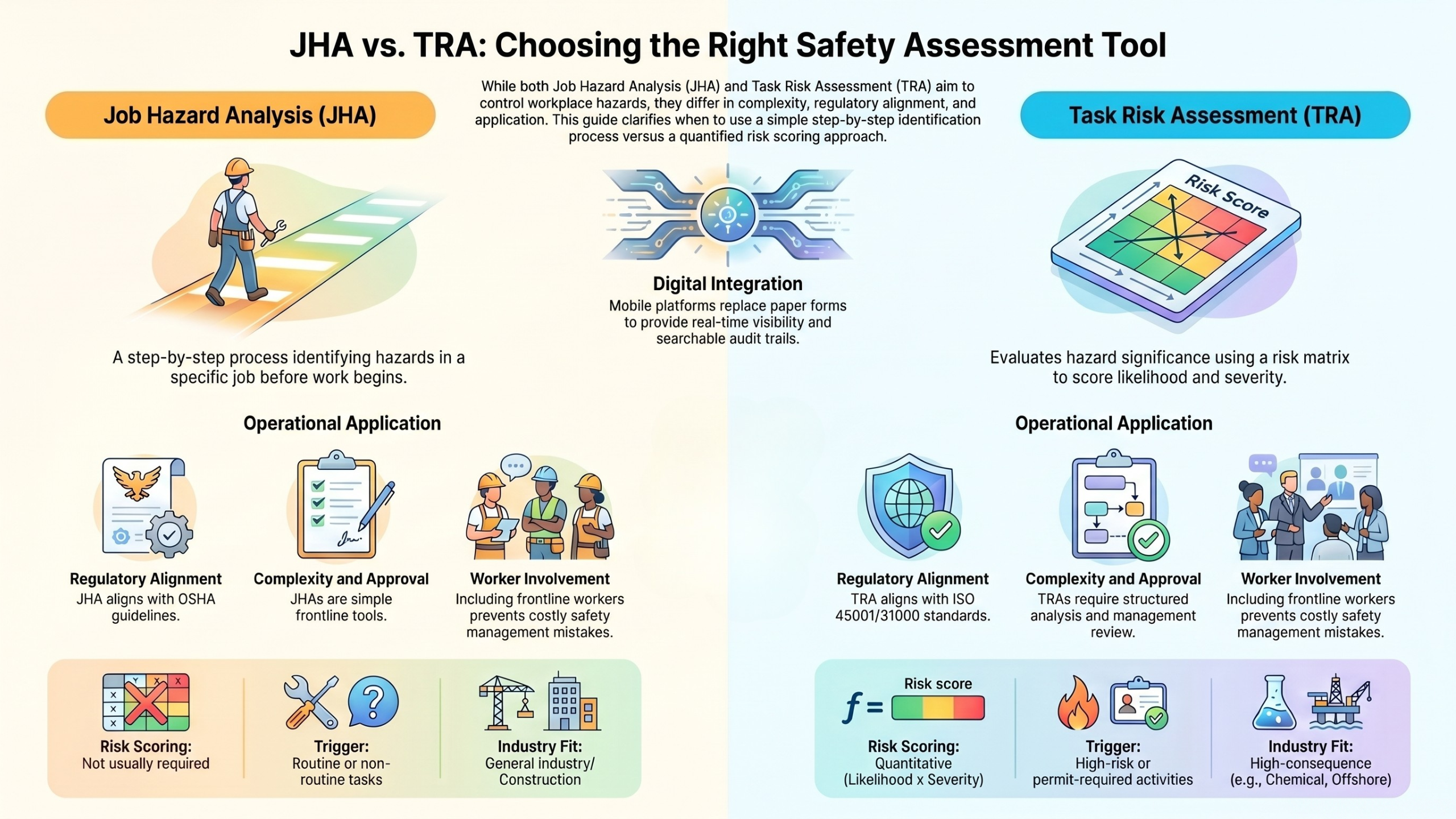
What is a Job Hazard Analysis?
A Job Hazard Analysis (JHA) also known as a Job Safety Analysis (JSA) is a step by step guide for identifying hazards in a particular job before you start work. You break the job down into tasks, identify the hazards in each one, and come up with controls to cut or reduce the risk.
OSHA has been championing Job Hazard Analysis as a frontline safety tool for ages, and it's widely used in construction, manufacturing, oil and gas, and general industry. You can find guidance and sample templates on OSHA's official resources.
A typical JHA form will include details on the job title, task steps, hazards at each step, required PPE, and recommended controls. It's meant to be simple enough for supervisors and workers to complete at the job site not just sit at a desk in an office.
What is a Task Risk Assessment?
A Task Risk Assessment (TRA) looks at not just what hazards exist, but how serious they actually are. It uses a risk matrix a grid showing the likelihood versus severity of the hazard to score the risk level and decide what controls and approval levels are needed before work can start.
TRAs are commonly used in high hazard environments like offshore oil and gas, utilities, and chemical plants. They fit in with frameworks like ISO 45001 and ISO 31000, and are often tied into Permit to Work systems where formal risk sign-off is required.
The Main Differences: JHA vs TRA
Here's a quick rundown of the main differences:
- Purpose - JHA concentrates on hazard identification per job step. TRA adds risk quantification (likelihood x severity) to figure out just how serious each hazard is.
- Risk Scoring - A standard JHA probably won't include a numerical risk score. A TRA always does.
- Complexity - JHAs are simpler and faster to complete suitable for frontline use. TRAs require a bit more structured analysis and often need review by management.
- Industry Fit - JHAs are the go to tool in construction, manufacturing, and general industry. TRAs are preferred in high-consequence environments where formal risk classification is required.
- OSHA Alignment - OSHA specifically mentions Job Hazard Analysis in its safety guidelines. TRAs line up more with ISO standards and industry specific regulatory frameworks.
- When to Use - JHAs are completed before any routine or non routine task. TRAs are typically done before high risk or permit required activities.
In practice, these tools aren't mutually exclusive. Loads of mature HSE programs use both: a JHA for the step by step hazard picture, and a TRA for the risk scoring layer that determines what authorization is needed.
The First Step in a Job Hazard Analysis?
First off, pick the right job to analyze. Prioritize tasks that have had previous incidents, are new or non-routine, or involve significant hazards like working at height, energy isolation, or confined space entry.
Once you've selected the job, break it down into steps (typically 5-15), identify hazards at each step, and then come up with controls. The analysis should be done before work starts not after.
Who Should Be Involved?
A Job Hazard Analysis is going to be most accurate if the people doing the job are part of creating it. OSHA recommends getting frontline workers, supervisors, and HSE professionals in on the review process. Workers know the real world conditions, HSE teams bring the regulatory know how, and supervisors provide the procedural context.
Don't try to do a JHA alone at a desk without any worker input that's one of the most common and costly mistakes in safety management.
What's the Role of Digital Tools?
Paper-based JHA forms create all sorts of problems: they get lost, are inconsistent, and there's no visibility into completion status. Digital HSE platforms put an end to this by letting you complete forms on site, integrating with Permit to Work workflows, and storing searchable audit trails for compliance and incident investigation.
Organizations adopting digital platforms like ToolKitX get better visibility, compliance assurance, and operational control instead of wrestling with manual paperwork, they can replace it with structured, real time safety workflows that actually get used on the ground.
What's the Key Takeaway?
Use a Job Hazard Analysis when you need a practical, step by step hazard identification tool that workers and supervisors can complete before starting any task. Use a Task Risk Assessment when the activity demands formal risk scoring and management authorization.
The best HSE programs use both in the right situations and they're supported by tools that make the process fast, consistent, and auditable.

Frequently Asked Questions
Q1 What is a Job Hazard Analysis (JHA)?
A Job Hazard Analysis is basically a systematic process that breaks down your job into its simplest parts, works out which bits are actually hazardous and then figures out how to cut those risks right back before you even start work. Its also jokingly referred to as a Job Safety Analysis (JSA).
Q2 What is the difference between JHA and TRA then?
Well, a JHA breaks the job down step by step to find where the hazards are. A TRA takes it a bit further. It actually does a scoring system for how likely and how bad the risks are. They then use it to decide what controls need to be put in to avoid those risks, and even if any higher-ups need to give approval for them.
Q3 What is the very first step in a Job Hazard Analysis?
First off you've got to pick the job you want to do an analysis on and no, that doesn't mean just picking any old job! You want to go for the high risk ones that are either brand new or non-standard to start with. Then you break it down into its individual steps, work out where the risks are, and how to mitigate them.
Q4 Who else should I get to have a look at a Job Hazard Analysis then?
You should get frontline workers, their immediate supervisors and HSE people on board OSHA actually encourages worker participation because it leads to a far more accurate picture of what the hazards are.
Q5 Can I use JHA and TRA together then?
Absolutely. In fact, a lot of HSE programs use them together. The JHA provides all the nitty gritty details on where the hazards are and how to mitigate them but the TRA adds in that extra layer of risk scoring that you want to formalize the work authorization especially if it's high risk, or actually requires a permit.