Incidents can pop up anywhere on construction sites, in manufacturing facilities, at utility networks or offshore installations. Some are major, some are minor and a lot more get missed altogether because they never get reported. The thing is, if we don't capture those minor events, we miss opportunities to identify the real hazards and do something about them before a more serious incident occurs.
That's why HSE Incident Reporting is a vital part of any Health, Safety, and Environment (HSE) management system. It's about more than just ticking off regulatory boxes it's about getting better at safety, better at managing risk and building a real safety culture. And as companies go digital, automated reporting tools are helping teams speed up their investigations and get a better look at what's going on.
What Is HSE Incident Reporting?
HSE Incident Reporting is the process of documenting, investigating and managing all the things that can happen in a workplace which might impact health, safety or the environment. These events can be anything from a serious injury or a near miss, environmental spillage or a broken machine, to some other safety or environmental issue.
So what's the point of all this reporting? Well, it's not just about putting down what happened a good report needs to tell us why it happened, what the root causes were and how we can stop it happening again in the future. Whether it's a worker getting hurt on site or a chemical leak in a factory, a report that's done properly gives us all the info we need to keep getting better.
Why Incident Reporting Really Matters
Every incident, no matter how big or small, gives us a chance to improve our safety record. A lot of big incidents have a history of smaller incidents or near misses that showed there were problems with the way things were running.
Effective reporting helps us work out where our most common hazards are, helps us keep up with the rules like ISO 45001, and makes it easier to make informed decisions about how to manage risk. It also helps us build a safety culture by encouraging staff to report any safety concerns and if people feel comfortable doing that, we get a much clearer view of the risks we need to be on top of.
What Should an Incident Report Actually Include?
If the investigation is going to be worth anything, we need to make sure the information we've collected is good. A decent incident report should have the date, time and where the incident happened, along with information about who was involved.
It should also tell us exactly what happened, what led up to the incident and any hazards that might have contributed to it. And of course, any supporting evidence we can get like photos or witness statements is invaluable. When we've finished the investigation, we need to be able to identify both the immediate cause and the deeper reasons behind what happened, and make sure we fix things properly. And all of this needs to be done quickly and accurately, so we can make sure those hard won lessons aren't lost down the line.
How the Incident Reporting Process Works in Practice
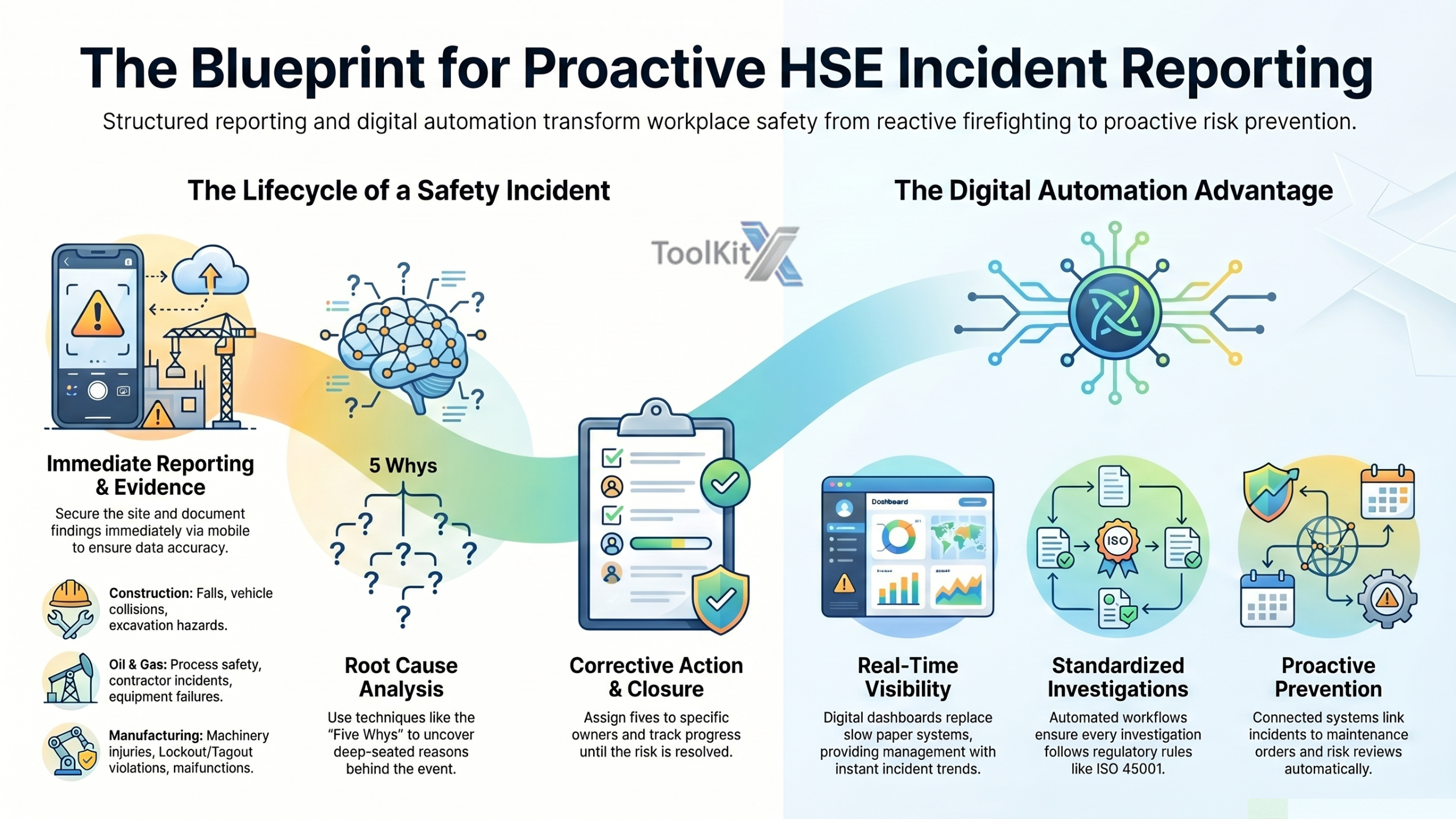
The incident reporting process starts with making sure everyone involved is safe, and then getting the incident reported to the right people in HSE.
The next step is to start documenting what happened and gathering up any evidence we might need. Then we use techniques like Root Cause Analysis or the Five Whys to get to the bottom of what went wrong. Based on our findings, we come up with some fixes and assign them to the right people and we don't close the case until those fixes have been done.
Common Challenges in HSE Incident Reporting
Despite its importance, many organizations struggle with incident reporting.
Underreporting
Employees may fear blame or disciplinary action.
Delayed Reporting
Critical details are often forgotten when reports are completed days later.
Inconsistent Data
Paper forms and spreadsheets frequently lead to incomplete records.
Lack of Investigation Follow Up
Corrective actions are assigned but not tracked effectively.
Limited Visibility
Management often lacks real time insight into incident trends.
These challenges can significantly weaken an organization's safety management system.
HSE Incident Reporting in Different Industries
HSE Incident Reporting plays a crucial role in high risk industries. In oil and gas operations, we use reporting to manage process safety events, contractor related incidents, and equipment failures. Construction companies use reporting tools to sort out falls, vehicle collisions, and excavation hazards.
In manufacturing, reporting helps us investigate machinery related injuries, Lockout/Tagout violations, and equipment malfunctions. And in utilities and renewable energy, reporting supports the management of electrical incidents, environmental events, and critical asset failures. Whatever the industry, the data we get from reporting helps us run a safer, more reliable operation.
How Automation Can Improve Incident Reporting
Traditional paper based systems often lead to delays, incomplete records, and a ton of paperwork. Modern HSE incident reporting software makes life a lot easier staff can submit reports straight from their mobile devices, so we get the information in real time. Automated notifications get the right people involved at the right time, and digital workflows help standardise our investigations.
Corrective actions get assigned, monitored, and escalated as needed and we get much clearer visibility into what's going on through dashboards and analytics. This lets us move from firefighting to proactive risk prevention.
The Future of Incident Management
As the world gets more tech savvy, and companies keep pushing the boundaries of digitization incident reporting is starting to tie the knot with risk assessments, audits, inspections, permits to work, and asset management processes all in one neat little package.
Take for instance an equipment break down, this can automatically kick off a maintenance work order, get a risk review underway, and remind the right teams what they need to do next. This way of doing things makes everyone more accountable and helps keep safety on track.
Platforms like ToolKitX are helping to bring this more connected approach to the fore by making it easy for companies to centralize safety info, get a clearer view of whats happening, and have a firmer grip on things across different sites and departments.