Every major workplace accident is usually preceded by several warning signs. In many cases, those warning signs are near misses that were either ignored, underreported, or never investigated. A worker narrowly avoiding a slip trip or fall, a forklift almost striking a pedestrian, or a dropped tool missing a technician by inches may seem insignificant at first. However, these events often expose weaknesses in safety controls and operational processes.
That's why near miss reporting has become a critical component of modern workplace safety and incident management programs. Rather than waiting for injuries to happen, or equipment to be damaged, organisations can use near miss reports to uncover hidden hazards, upgrade their risk controls, and prevent future incidents from even happening.
What Is a Near Miss?
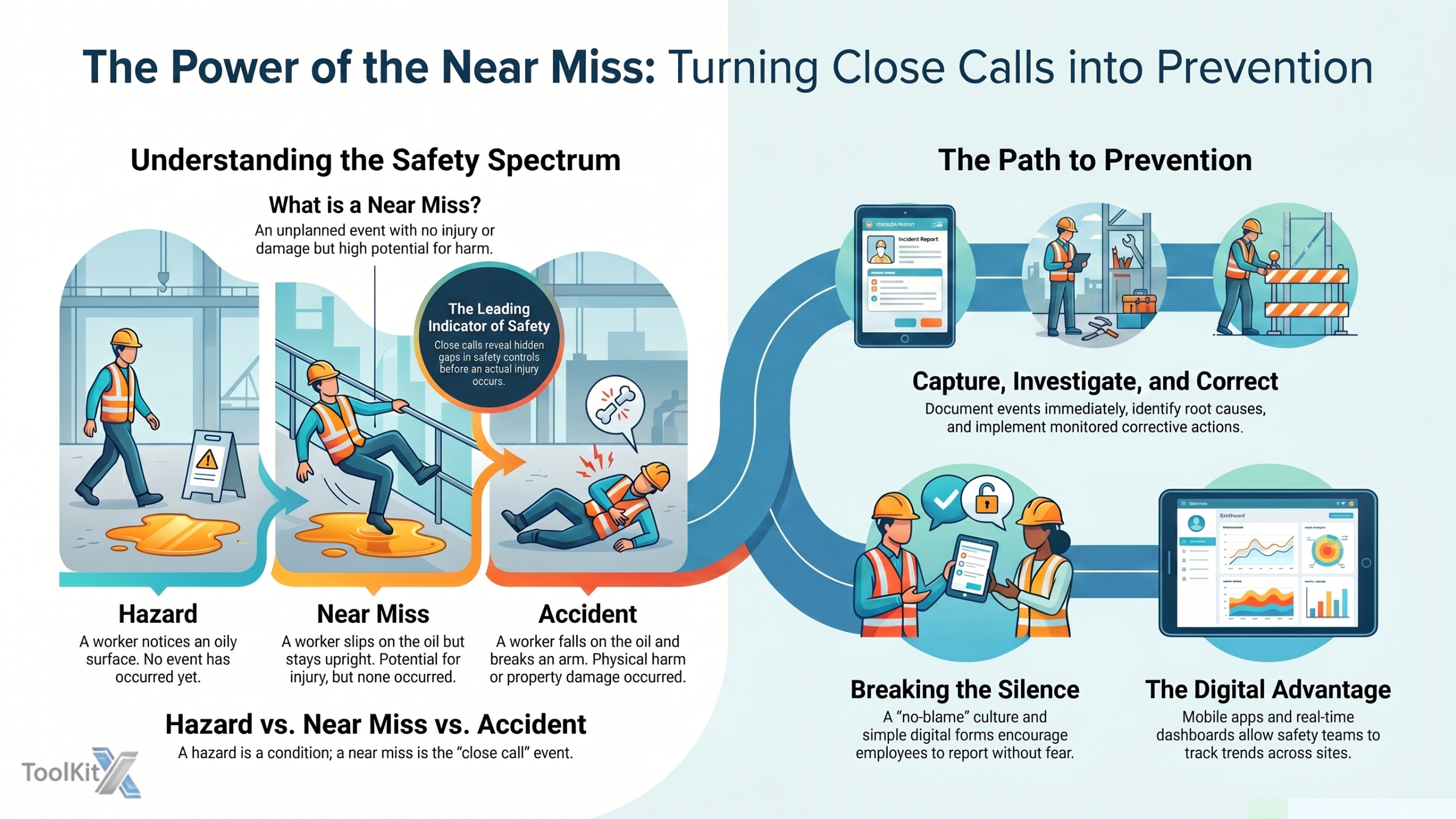
The near miss definition in safety terms refers to an unplanned event that didn't quite cause any harm no injuries, no property damage but had all the makings of a nasty accident. In other words, a near miss is a close call or a near accident.
If a worker slips on an oily floor but manages to keep their balance, that's a near miss in safety. If they fall and get hurt, well, it's an accident and that needs a workplace accident report and a good hard look.
Understanding what is a near miss in safety, is crucial because they give us a chance to address risks before they get out of hand and turn into serious incidents. And many organisations would argue that near misses are the best leading indicators of overall safety performance.
Why Near Miss Reporting Matters
Near misses tell us what our safety controls are missing when it comes to eliminating hazards. By reporting these close calls, we get to see how work is really done and where the gaps in our safety net are.
For example, in construction, if we see a pattern of workers narrowly avoiding slips on uneven surfaces, it might mean that our housekeeping procedures or pedestrian route planning are falling short. In manufacturing, a bunch of reports of forklifts nearly hitting people could mean our traffic management systems are in need of some TLC.
An effective near miss reporting process helps organizations:
- Identify hazards before injuries occur
- Improve risk assessments and control measures
- Prevent recurring workplace incidents
- Strengthen safety culture and employee engagement
- Support continuous improvement initiatives
Unlike traditional incident report or accident incident report, which documents what's happened after it's too late, a near miss report lets us intervene early, before things get out of hand.
Incident vs Near Miss: What's The Difference?
Safety pros often use the terms incident, accident, and near miss like they're interchangeable, but they're not. There's a clear distinction.
A hazard is a potential safety risk, something that could go wrong like a faulty cable or a slippery floor. A near miss occurs when something goes wrong but doesn't cause any harm. An incident may or may not be a problem, while an accident results in actual harm or damage.
Consider a common example involving slips and trips in the workplace. A worker notices water on the floor and avoids the area. The wet surface is the hazard. Another employee slips but regains balance without injury. This becomes a near miss. If the employee falls and fractures an arm, it becomes an accident requiring investigation and reporting.
Understanding these distinctions improves reporting accuracy and ensures organizations capture valuable learning opportunities.
How Near Miss Reporting Works
A good near miss reporting system is more than just filling out a form its a structured process that turns observations into tangible improvements.
It usually starts when someone on the ground spots a potentially dodgy situation or experiences a close call. We want them to document that ASAP with a near miss reporting form, mobile app or digital reporting platform. And when we fill that in, we should give all the juicy details, from where it happened to what could've gone wrong and what we did to fix it.
Once its in, someone will investigate the event to figure out what went wrong and more importantly, why. In a lot of cases, the root cause is going to be something deeper than a careless worker maybe the procedure was out of date, staff hadn't been trained properly, poor equipment design or the supervision was lacking.
Finally, something gets done about it, it gets monitored and reviewed to make sure the risk is genuinely under control.
Near Miss Examples Across Industries
Near misses occur in every industry, although the hazards often differ.
In construction, common near miss examples in construction include tools falling from height, workers narrowly avoiding contact with moving plant equipment, and temporary structures becoming unstable during adverse weather conditions.
In manufacturing environments, examples of near misses include machinery starting unexpectedly during maintenance activities, forklifts almost colliding with pedestrians, and chemical spills that are contained before exposure occurs.
Utilities and energy facilities frequently encounter near misses involving electrical hazards, confined spaces, and dropped objects. Offshore operations may also experience equipment failures that have the potential to escalate rapidly if not addressed.
These examples of near miss incidents demonstrate why organizations should investigate every close call, regardless of whether an injury occurred.
Why Near Misses Often Go Unreported
Despite their importance, many near misses are never reported. Employees often assume that if nobody was injured, reporting the event is unnecessary. Others may avoid reporting because they fear blame or believe management will not take meaningful action.
Complex paper based reporting systems can also discourage participation. If employees need significant time to complete forms or do not receive feedback after submitting reports, reporting rates tend to decline.
Organizations that build strong reporting cultures usually adopt a no blame approach. Employees are encouraged to report hazards, unsafe conditions, and good catches without fear of criticism. This approach improves visibility into operational risks and promotes continuous learning.
How Digital Near Miss Reporting Software Improves Accuracy
Traditional paper forms and spreadsheets often create delays and inconsistencies in incident management. Reports may be incomplete, difficult to access, or lost entirely.
Near Miss Reporting Software for example gets around these problems by providing a defined and standardised way of reporting incidents.
Digital reporting systems offer several advantages:
- Immediate reporting through mobile devices
- Standardized incident report forms and templates
- Automated notifications and investigation workflows
- Centralized incident logs and dashboards
- Trend analysis and performance reporting
For organisations with multiple sites, digital reporting really helps improve data quality and visibility. Your safety team is able to identify recurring hazards, keep an eye on corrective actions and track trends across different locations.
For example repeated reports of 'falls in the workplace' at several sites might indicate a more general issue with housekeeping standards or contractor management processes. Without a centralised reporting and analytics system, these kinds of patterns can easily get overlooked.
Platforms like ToolKitX are helping to drive the adoption of incident reporting systems by enabling people to capture near misses, investigate root causes, assign corrective actions and keep track of operational risks.
Best Practices for Effective Near Miss Reporting
The most successful organisations treat near miss reporting as a key part of their overall approach to operational excellence, rather than just a matter of ticking boxes.
Employees need training on what are near misses, why it matters and how to submit a report correctly. The reporting process needs to be simple and easy to use, so that workers can document what happened quickly.
Organizations should also investigate every near miss, communicate lessons learned, and regularly review trends to identify recurring hazards. Leadership involvement is equally important. When employees see management responding to reports and implementing improvements, reporting participation typically increases.
Ultimately, the value of near miss reporting lies not in the number of reports submitted but in the actions taken to prevent future incidents.
Conclusion
Near miss reporting is one of the most effective proactive safety practices available to organisations operating in high risk environments. By understanding what is the definition of a near miss, encouraging employees to report close calls and implementing effective investigation processes, organisations can identify hazards before they cause injuries or damage.
Whether it's dealing with slips, trips and falls, equipment failures or process deficiencies, every near miss report represents an opportunity to improve safety performance. As organisations continue their digital transformation journeys, modern incident reporting platforms and near miss reporting software are providing the visibility and accuracy that's needed to make better decisions and build safer, more resilient operations.
Frequently Asked Questions
Does a near miss need to be reported?
Yes, even though not every near miss is formally reportable under regulations, reporting near misses really helps organisations identify hazards and prevent future incidents.
What is the technical term for a near miss?
A near miss is often referred to as a close call, or a dangerous occurrence - it's an incident that had the potential to cause injury or damage.
What information should a near miss report include?
A near miss report should include the date, location, description of the incident, potential consequences, immediate actions taken and suggested corrective actions.
Why should you report near misses?
Near miss reporting helps organisations identify hazards early, improve risk management processes, build a stronger safety culture and reduce the likelihood of future accidents.
What is a near miss in healthcare?
In a healthcare setting a near miss is an incident that could have caused patient harm but didn't because of timely intervention, luck or corrective action before the patient was affected.