An HSE Plan (Health, Safety and Environment Plan) is essentially a blueprint that lays out how a project or organisation will tackle hazards, mitigate risks, protect workers, manage environmental impacts, and respond to emergencies. It takes those broad HSE commitments and turns them into practical, everyday actions that staff can follow procedures, controls, monitoring activities the works. And for project work, the plan needs to be tailored to the actual site, reflect what's really going on out there, and get updated when circumstances change.
Right now, the current HSE guidance and professional resources all emphasize the importance of identifying hazards, controlling risks, getting workers involved, training them up, being prepared for emergencies, and making sure there's continual improvement in all of those areas all core elements of successful safety management.
Why Is an HSE Plan Important?
A good HSE management plan is more than a compliance document. It provides the operating framework for managing HSE risks throughout a project.
For a construction or engineering project, it helps teams understand:
- Which hazards are associated with planned activities
- Who is responsible for specific HSE duties
- What risk controls must be implemented
- What training and competency requirements apply
- How incidents and near misses are reported
- What happens during an emergency
- How inspections, audits, and HSE KPIs will be monitored
A good plan also helps create a connection between what management wants to happen and what's actually going on out on the site. In the US, for example, OSHA recommends management leadership, worker participation, hazard identification and assessment, hazard prevention and control, training, evaluation, and communication as core elements of a strong safety and health program.
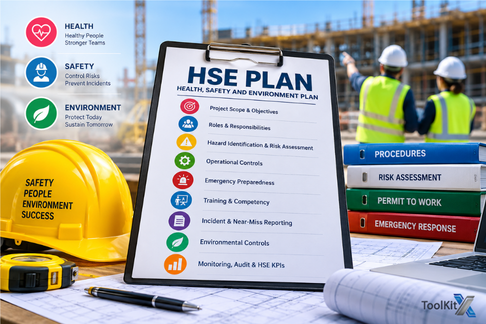
What Should an HSE Plan Include?
The exact HSE plan contents depend on the organization, contract, location, industry, and risk profile. However, a practical project HSE plan commonly addresses the following areas.
Project scope and objectives: This section outlines the project, the location, the activities, the duration, any interfaces with other projects and the HSE objectives.
HSE policy and responsibilities: This defines what the leadership team is committed to, and who's responsible for each HSE activity from project managers to HSE staff, and all the way down to workers and contractors.
Hazard identification and risk assessment: This is where you identify any hazards and work out how to control the risks. You'll probably use a combination of methods such as HIRA, HEMP, JSA, or JHA to help with this. The plan should explain how you'll go about selecting and verifying the controls you choose.
Operational controls: This is where you reference any applicable procedures, RAMS, method statements, PPE requirements, safe work practices, and Permit to Work controls for high risk activities.
Emergency preparedness: This sets out what you'll do in the event of an emergency, including communication, evacuation, first aid, emergency contacts, and response responsibilities.
Training and competency: This defines what induction training is needed, what task specific training is required, when toolbox talks should happen, how you'll verify competency and how often refresher training is needed.
Incident and near miss reporting: This explains how incidents are reported, investigated, communicated, and acted on so you can learn from them and make changes to prevent them happening again.
Environmental controls: This addresses any environmental aspects that are relevant to the project like waste, emissions, spills, resource use, and environmental emergencies.
Monitoring and review: This sets out how you'll track progress, do inspections and audits, keep an eye on HSE performance metrics and make changes as needed
These components are consistent with the structure found in current project HSE guidance and construction resources.
How Do You Prepare an HSE Plan?
The strongest project HSE plan starts with the project itself, not a generic template.
-
Understand the project
First, get a good understanding of just what the project involves the scope of work, the site conditions, the schedule, the workforce, the equipment, materials, subcontractors, and interfaces with other operations. Think about any unusual conditions that might affect the project like simultaneous activities, live facilities, restricted access, or changing work locations.
-
Identify requirements
Next, figure out what laws, client requirements, contractual obligations, internal procedures, and management system requirements apply to the project. You should also consider any environmental requirements that might be relevant. In the US, for example, OSHA is the relevant authority for occupational health and safety and the US Environmental Protection Agency is the one to turn to for environmental issues.
-
Perform hazard identification and risk assessment
Now, take the project and identify what could cause harm. Assess those risks and define controls using the hierarchy of controls, and suitable task level assessments. Think of it like this: identify hazards, assess the risks, and then select controls to manage those risks.
-
Define responsibilities and controls
Specify who owns each HSE activity and how it will be managed. Connect the plan to RAMS, JSA/JHA, Permit to Work, emergency procedures, training programs, inspections, and incident reporting.
-
Establish measurable monitoring
Set practical HSE KPIs and monitoring activities. These may include training completion, inspections, corrective action closure, observations, near miss reporting, or other indicators suited to the project.
-
Review, approve, and implement
Before work begins, review the plan with the relevant project stakeholders. And don't even think about submitting a plan that hasn't been properly tailored to the actual project construction guidance warns against that all the time.
Once its OK'd, make sure to inform the workforce and incorporate it into the day to day activities of the site.
HSE Plan vs. HSE Management System
A HSE plan is basically a document listing how Health, Safety & Environmental requirements are going to be implemented for a specific part of a project. An HSE management system is the overall framework of policies, procedures, people's roles, records, checks and balances, and ways to keep on improving all used across a business.
To put it simply: the management system gives the overall framework and the HSE plan explains just how that framework will be put into action for a specific project or job.
When Should an HSE Plan Be Reviewed?
An HSE Plan is not something you can just write up and then leave on the shelf. You should review it when changes occur which affect the risks, such as if the scope of a project changes, the site conditions change, or if you've got new or different equipment, materials, methods of work, new contractors in, or you need to change emergency procedures.
The Occupational Safety and Health Administration (OSHA) also says you should re check the hazards when your work practices, materials or work layout change.
Frequently Asked Questions
What is the main purpose of an HSE Plan?
Its main purpose is to lay out how to manage health, safety and environmental risks for a specific project, business, site or activity. It sets out the responsibilities, risk controls, emergency procedures, training, reporting and monitoring requirements.
Who prepares an HSE Plan?
Usually an HSE specialist will work with the project team, the engineers involved, the operations people, supervisors and other relevant team members. Just who does the writing and who's responsible will depend on your business's governance rules and contractual obligations.
Can I use an HSE Plan template?
Yes. An HSE plan template can give you a useful starting point, but you need to make sure it is customized to the actual job in hand, including the risks, legal requirements, workforce and site conditions. No use just plugging in a generic template and thinking that's it.
What is a site specific HSE Plan?
A site specific HSE plan is tailored to the specific location, activities, hazards, interfaces, resources and working conditions of a particular site. What makes it valuable is that it reflects the specific conditions of the job rather than just regurgitating generic safety procedures.
What is included in an HSE plan checklist?
An HSE plan checklist will usually cover off scope, responsibilities, risk assessments, controls, training, personal protective equipment, emergency response, reporting, environmental requirements, inspections, KPIs, document control, approvals and review processes.
Final Takeaway
A good HSE Plan is not just a piece of paper to tick off the boxes. Its a practical guide for keeping risks under control right through the job. Best to start off with your actual project in mind, identify the hazards, assign responsibilities, define controls, set up the emergency and monitoring processes, and continually review and update the plan as things change.
For teams putting one in place for the first time, the logical next step is to build a structured HSE plan checklist around the project's scope, risks, controls, responsibilities and approval requirements.