A proactive safety program does not wait for an injury, equipment failure, or regulatory finding to reveal a weakness. It looks for hazards, near misses, recurring findings, overdue actions, and warning signals early enough to intervene. HSE management software helps by connecting risk assessments, inspections, incident management, corrective actions, and safety analytics in one digital environment, turning scattered safety activity into a repeatable prevention process.
What Makes Safety Management Proactive?
Reactive safety management tends to look back over its shoulder you know, the old "well that went wrong, let's investigate & fix it" routine. And while that still has a place, it's not enough on its own.
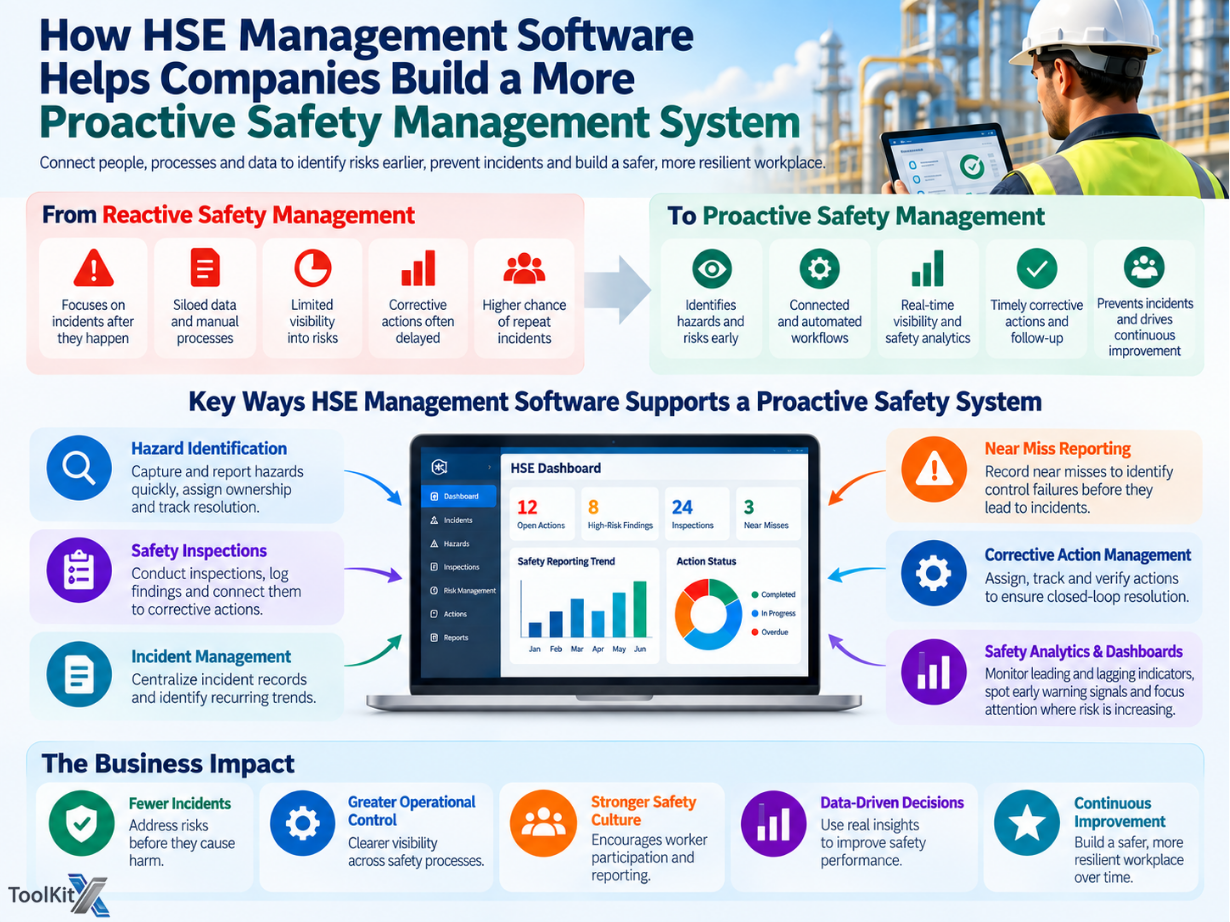
Proactive safety management on the other hand is all about looking forward & figuring out what we can do differently to stop problems from arising in the future. One big part of this is a thing called leading indicators. OSHA puts it like this: proactive & preventive steps that will help us spot potential issues with the safety program eg a hazard report slips in, a near miss, an inspection turns up something untoward, the workers start making suggestions for improvement... & also, how fast do we get round to sorting out the corrective actions that need doing.
An HSE management system can support a continuous loop: identify hazards, assess risk, assign controls, verify completion, analyze results, and improve.
How HSE Management Software Supports Proactive Risk Management
The real value of HSE software lies in its ability to tie together all the different bits of information that are usually kept separate, rather than just slapping a digital coat of paint on old paper forms.
Hazard identification becomes a whole lot more useful when your workers can pop up a quick record of any dodgy conditions they find and get it bounced over to the right person right away. But a safety observation shouldn't just end up as some database entry it should actually create a sense of ownership, set a deadline, and schedule a follow up to check on things. That way you get a nice little closed loop process going where the risks you've identified are actually linked up with what's going to happen about them.
Near miss reporting is pretty crucial too. A near miss can reveal that one of your safety controls has failed without causing an actual injury. When you start looking at all that near miss data alongside your inspections and risk assessments, you can often spot recurring patterns and step in before anything more serious happens. OSHA reckons near misses along with hazards, inspections and how fast you fix problems are all useful leading indicators.
Safety inspections and HSE audits are a whole lot more useful when their findings can feed right into the rest of your safety workflow rather than getting stuck away somewhere on their own. So rather than saving off an inspection report on its own, a good digital HSE management system will tie it all together finding to risk, to action owner, due date and follow up evidence. That makes it all a lot more traceable and means you can ditch those spreadsheets, emails and manual follow ups.
From Safety Data to Early Warning Signals
To really make a proactive program work, you need visibility and it's not just about collecting a bunch of data. HSE dashboards do a great job of bringing together all the key safety indicators and lagging outcomes so managers can actually see at a glance if preventive efforts are either holding up or falling apart.
Useful signals may include inspection completion, open high risk findings, overdue corrective actions, near miss reporting activity, training completion, or repeated hazards. OSHA recommends monitoring both leading and lagging measures and reviewing trends over time. This matters because an organization can have few recorded injuries while still having weak reporting, overdue actions, or poor inspection performance.
A really useful safety analytics tool is one that can connect the dots between activity and risk. For example, if the same piece of equipment, job task, or work location keeps coming up time and again in inspection reports that may be a sign that the controls in place just aren't working or that the underlying risk assessment needs to be given another look over. OSHA also suggests grouping up all the reported incidents and hazards to see if there are any emerging trends, and using the results of inspections to help prioritize getting things fixed.
Building a More Connected HSE Management System
Technology is at its best when it helps to put a solid safety process in place. ISO 45001 spells out a blueprint for occupational health & safety management that includes getting your leadership team involved, getting your workers engaged, figuring out where potential hazards lurk and how much of a risk they pose, putting in place operational controls, regular audits, and the goal of constantly finding ways to improve. Safety management software can make it easier to stay on top of these processes by ironing out your workflows, keeping all your records tidy and easily accessible, and making it simpler to get a handle on how your safety program is doing overall. But it's worth noting that it can't replace the value of a well trained safety pro, or experts who know how to do thorough risk assessments, or management being held accountable.
A safety management system rollout should start in the places where the biggest risks are lurking rather than trying to tackle everything at once. That means first and most importantly figuring out what your most critical hazards are, making it clear who is responsible for taking action, picking the metrics that actually mean something, and making it dead easy for frontline staff to raise the alarm about any issues they see. Then you can use all that data to tighten up your controls and cut through all the noise to focus management's attention on the places where the real risks are.
Conclusion
The shift from reactive safety management to proactive safety management is fundamentally a shift in how an organization uses information. HSE management software can connect frontline reporting with risk assessment, corrective action management, audits, inspections, and analytics, giving leaders earlier visibility into conditions that deserve attention. The practical next step is to map your safety workflow and identify where information gets lost or delayed.