Workplace safety management is evolving as organizations look for smarter ways to identify hazards, prevent accidents and protect employees. Traditional safety practices often depend on manual inspections, incident reports and periodic risk assessments. While these methods remain important, they may not always identify emerging risks quickly enough.
AI in workplace safety is changing this approach by helping organizations analyse large amounts of information, identify potential hazards and make more informed safety decisions. From predictive risk assessment to automated inspections, artificial intelligence is creating new opportunities to improve Health, Safety and Environment (HSE) management.
What Is AI in Workplace Safety?
AI in workplace safety refers to the use of artificial intelligence technologies to help spot hazards, look at safety info, monitor workplace conditions and support accident prevention.
These technologies use machine learning, computer vision, predictive analytics and natural language processing to identify patterns that are tough to pick up on through manual processes.
For instance, an AI powered monitoring system can look at camera footage to spot when personal protective equipment (PPE) is missing, while predictive analytics can sift through historical incident records to highlight recurring workplace risks.
AI is not a replacement for safety professionals it's there to provide extra information and analytical capabilities to support better informed decisions.
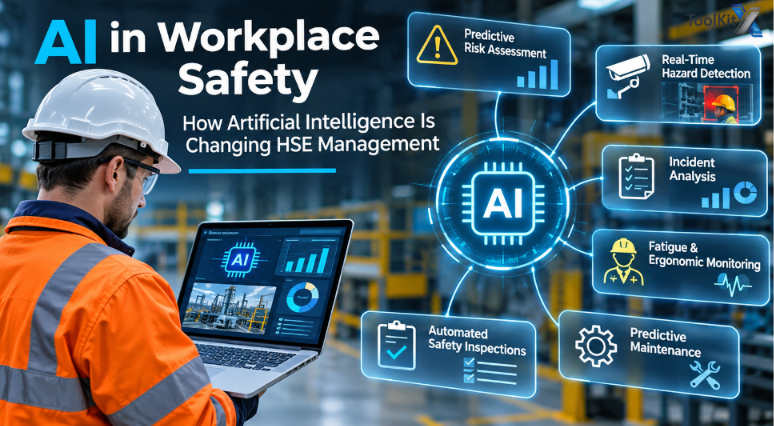
6 Ways AI Is Transforming Workplace Safety Management
-
Predictive Risk Assessment
Traditional risk assessments often rely on inspections, historical incident records and professional experience. AI can strengthen this process by analysing information from multiple sources, including near miss reports, equipment records and workplace observations.
Machine learning algorithms can identify recurring patterns and highlight areas where risks may be increasing.
For example, if a few near miss incidents keep happening around a certain machine, an AI assisted analysis might identify the pattern and alert safety teams to take a closer look.
This helps organisations shift towards proactive risk management rather than relying on incidents that have already occurred.
-
Real Time Hazard Detection
Computer vision lets AI systems have a look at images and video footage to spot potential workplace hazards.
Depending on the system and its configuration, applications may include detecting:
- Workers entering restricted areas.
- Missing helmets, safety vests or other required PPE.
- Unsafe proximity to operating machinery.
- Blocked emergency exits and walkways.
- Potentially unsafe working conditions.
When a possible hazard gets flagged, the system can send an alert to the responsible supervisor or safety team for review.
This gives organisations better visibility into workplace conditions and can help them respond faster to potential hazards.
-
AI Powered Incident Reporting and Investigation
Incident reporting is an essential part of HSE management, but reviewing large volumes of reports manually can be time consuming.
AI powered tools can analyse incident descriptions, identify recurring keywords, group similar events and help highlight potential underlying causes.
Generative AI can also assist with summarizing incident reports and organizing information for investigations.
For example, when multiple incidents involve similar equipment or working conditions, AI assisted analysis can help investigators recognize common patterns.
However, AI generated findings should always be reviewed by qualified safety professionals before conclusions or corrective actions are approved.
-
Worker Fatigue and Ergonomic Risk Monitoring
Worker fatigue and poor ergonomics can increase the likelihood of workplace injuries, particularly in physically demanding and high risk industries.
AI can analyse information from wearable devices, operational schedules and suitable monitoring technologies to help identify potential fatigue related risks.
Similarly, computer vision and motion analysis technologies can help assess posture, repetitive movements and other ergonomic risk factors.
These applications can support earlier intervention, better work planning and improved occupational health management.
Employee privacy and informed, proportionate monitoring are essential when introducing these technologies.
-
Automated Safety Inspections and Documentation
Safety inspections, audits and compliance documentation require significant administrative effort.
AI can help streamline these activities by analysing inspection records, identifying missing information, summarizing findings and highlighting recurring issues.
For example, an AI assisted inspection system may help identify incomplete inspection records or recurring equipment defects that require further investigation.
Natural language processing can also help safety teams search large collections of procedures, safety documents and incident records more efficiently.
This reduces repetitive administrative work and allows HSE professionals to spend more time addressing workplace risks.
-
Predictive Maintenance and Equipment Safety
Equipment failure can create serious workplace hazards, particularly in manufacturing, construction and industrial operations.
AI powered predictive maintenance systems analyse information such as temperature, vibration, operating conditions and equipment performance.
By identifying unusual patterns, these systems can help maintenance teams recognize potential equipment problems before a failure occurs.
This supports better maintenance planning, reduces unexpected downtime and can help prevent equipment related safety incidents.
Benefits of AI in HSE Management
When implemented appropriately, AI can deliver several benefits to workplace safety programmes:
- Earlier hazard identification: Helps identify potential risks through continuous data analysis.
- Better risk assessment: Reveals patterns in historical and real time safety information.
- Faster incident analysis: Helps safety teams review reports and recognize recurring issues.
- Improved operational efficiency: Reduces repetitive reporting and documentation tasks.
- Better safety visibility: Provides additional information about workplace conditions.
- Data driven decisions: Supports more informed safety planning and corrective actions.
However, these benefits depend on data quality, system reliability, appropriate implementation and effective human oversight. AI does not guarantee accident prevention.
Challenges of Using AI in Workplace Safety
Despite all the benefits, implementing AI creates some major challenges that organisations need to consider before taking the plunge.
Having poor quality data can end up producing predictions that are completely off the mark, and computer vision systems will often produce false alarms or maybe even miss some hazards altogether, especially if the lighting or camera setup is subpar.
Privacy is also a big issue, especially when it comes to workplace cameras and wearable devices. And organisations need to think about things like cybersecurity, avoiding algorithmic bias, getting the tech to integrate properly, and getting people to actually use the thing.
Most importantly, AI recommendations should definitely not replace good old fashioned professional judgment, or established safety procedures.
We really can't stress enough how important it is that human oversight is still in the driving seat when it comes to making safety critical decisions.
How Can Organizations Implement AI in HSE Management?
To avoid the pitfalls, organisations should start by identifying a specific safety challenge thats holding them back, rather than just jumping in with AI because its a shiny new toy.
A practical implementation approach includes:
- Identify safety priorities: Determine which workplace risks or administrative processes need improvement.
- Evaluate available data: Review incident records, inspection reports, equipment information and existing digital systems.
- Select appropriate technology: Choose AI applications that address the identified safety requirements.
- Start with a pilot project: Test the technology in a controlled workplace environment.
- Train employees: Help workers, supervisors and HSE professionals understand how the system operates.
- Monitor performance: Evaluate accuracy, response times, corrective actions and actual safety outcomes.
AI initiatives should also align with the organization's occupational health and safety management framework, including relevant ISO 45001 requirements.
The Future of AI in Workplace Safety
The future of workplace safety is going to see AI play a more and more important role. Advances in predictive analytics, connected sensors, computer vision and generative AI are all going to open up new opportunities to spot hazards and improve safety processes.
However, successful adoption will depend on more than technology. Organizations need reliable data, appropriate governance, employee involvement and qualified professionals who can interpret AI generated information.
The future of workplace safety is not about replacing human expertise with artificial intelligence. It is about combining human judgment with intelligent technology to create safer, more proactive working environments.
Frequently Asked Questions About AI in Workplace Safety
-
How is AI used in workplace safety?
AI steps in to help identify potential hazards, get a handle on risk levels, keep an eye on working conditions and dig through incident data to find patterns all thanks to some pretty smart tech like machine learning, computer vision and predictive analytics.
-
Can AI predict workplace accidents?
AI analyses incident records, near misses and equipment data to identify potential risks. However, it cannot predict every accident with certainty.
-
What are the main benefits of AI in HSE management?
Using AI really helps out with hazard detection, risk assessment, getting to the bottom of incidents and making safety reports and in the process it helps to cut back on all that repetitive, boring paperwork.
-
What are the risks of using AI in workplace safety?
You've got to watch out for inaccurate predictions, false alarms, data privacy worries, bias in the algorithms and cybersecurity threats. And the bottom line is that you still need human oversight to make sure everything runs smoothly.
-
Does AI replace HSE professionals?
No chance, AI is there to help out with data analysis and hazard detection but when it comes down to the tough safety calls and figuring out what to do next, you still need human brains and expertise.