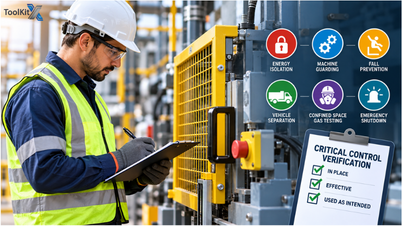
In high risk work, just having a written procedure in place won't necessarily mean that people are protected. A machine guard can be listed in a document as being in place, but actually be missing from the equipment. An isolation procedure can exist, but that doesn't mean that the energy is actually turned off. Critical control verification checks to see if the safeguards that are designed to prevent serious incidents are actually in place, working as they should, and being used the way they are meant to be used.
What Are Critical Controls in Safety?
Critical controls are the safeguards that are absolutely essential for preventing a really bad incident, or at the very least, reducing its impact. If any of them are missing or not working properly, the likelihood of a serious incident going wrong is going to increase, even if other controls are in place. The International Council on Mining and Metals (ICMM) describes critical control management as a systematic way to make sure these safeguards are put in place and are working properly.
Some examples include energy isolation, machine guarding, fall prevention, vehicle separation, confined space gas testing and emergency shutdown systems. Don't just pick critical controls from a generic checklist choose them based on a site specific risk assessment.
Why Critical Control Verification Matters
Managing critical controls focuses attention on the safeguards that are most important for preventing serious harm and fatalities. Verification checks to see if the controls are actually working in real life operating conditions, rather than just assuming that they will because they appear in a risk register or in an operating procedure.
The ICMM's 2026 good practice guide makes it clear that performance requirements, accountability, verification, and taking action on any gaps are all key. OSHA guidance also recommends checking that the controls are still effective in protecting workers, and involving workers in that review. Just apply the relevant regulations and site procedures.
How to Verify Critical Controls in the Field
A practical critical control verification process answers five key questions: What's the control supposed to do? What does it look like when it's working properly? How are you going to check on it? Who's responsible for checking on it? And what happens if it fails to do its job?
- Identify the hazard and control. Use the risk assessment or bowtie analysis to link the control to the event it must prevent or mitigate.
- Define performance standards. Be clear about what's expected. "Check the guard" is a bit vague; "the guard is secure and the interlock stops the machine when it's opened" is much more concrete.
- Choose evidence and method. Depending on the control, you might use a combination of field observation, authorized functional test, readings, record reviews or conversations with workers.
- Assign responsibility and frequency. Choose a competent verifier and a schedule based on failure modes, exposure, operating conditions, and site requirements. Some checks belong before each task; others require periodic technical testing.
- Record findings and close the loop. Record the result, evidence, verifier and actions. Re verify after corrective work; a closed task is not proof that the control meets its standard.
Example: Verifying a Confined Space Control
Before letting workers enter a tank, atmospheric testing is a critical control. Just checking that there is a detector and a permit in place isn't enough verification you need to confirm that the detector is in good working order, that the testing was done properly, that the readings are within the required limits and that ongoing monitoring is in line with the level of risk.
If the control is failing, work on the tank must stop immediately or it must be made safe before anyone can carry on. Fix the issue and then verify that the safeguards are in place and working properly before any further work is carried out.
Who Is Responsible, and What If a Control Fails?
Operational leaders and the control owners are responsible for making sure verification happens. Supervisors and frontline workers do the task level checks, but HSE professionals or technical specialists can provide oversight or independent assurance. Make the responsibilities clear.
If a critical control fails, manage the immediate risk, escalate the issue, stop the activity or modify it if necessary, restore the control or put in place an approved interim solution, assign corrective action, and verify that the control is working properly before relying on it again. Review any repeat failures to see if there's a bigger underlying issue.
Make Verification More Than Paperwork
A critical control verification checklist should show off the control, the performance standard, the method, the result, the evidence, the owner, the corrective action and the closure status. Don't just rely on whether the forms get completed look at failed checks, overdue high risk actions and repeat failures to see if there's a bigger issue that's being hidden.
Digital critical control verification tools can help keep track of schedules, evidence and corrective actions across multiple sites, but technology on its own can't prove effectiveness. The quality of the criteria and the field checks is what really matters.
Frequently Asked Questions
What Is Critical Control Verification?
It's a structured process to check whether a critical control is actually working as it should in practice. Evidence might include observations, tests, readings or records and if there are any gaps in the control, they should be followed up with action.
How Often Should Critical Controls Be Verified?
There's no one size fits all answer just base it on the level of risk, how the control can fail, changing conditions, regulations and site procedures. Some controls might need checks before every task, while others might need scheduled technical testing.
Who Should Verify Critical Controls?
The verifier should be competent to carry out the specific check. Supervisors and frontline teams may do the task level checks, while the control owners, techical specialists or HSE personnel do any additional reviews that are needed.
What Should Happen When a Critical Control Fails?
Manage immediate risk first. Stop or change the activity when required, escalate the failure, restore the safeguard and verify it meets its standard before relying on it. Record actions and address causes to prevent recurrence.
How Is Verification Different From a Routine Safety Inspection?
A routine inspection can identify a wide range of hazards. Critical control verification focuses on safeguards essential to preventing or mitigating serious events and checks them against defined performance criteria.