Lockout/Tagout (LOTO) is one of the most regulated safety procedures in industrial history. And yet, LOTO failures continue to injure and kill workers every year across manufacturing, oil & gas, food processing, and utilities. The problem is rarely ignorance of the procedure. It is almost always a gap in how that procedure is applied, verified, or enforced under real working conditions.
Below are seven documented industrial incidents where LOTO controls failed and what each reveals about the true nature of hazardous energy control in practice.
What Is LOTO?
LOTO (Lockout/Tagout) is a safety procedure governed by OSHA Standard 29 CFR 1910.147, requiring that machines be fully shut down, isolated from all energy sources, and physically locked before maintenance or servicing begins. It covers electrical, hydraulic, pneumatic, thermal, gravitational, and stored energy. Equivalent frameworks exist under ISO 45001, the EU Machinery Directive, and national HSE regulations.
LOTO failures typically occur when procedures are incomplete, training is informal, contractors are poorly coordinated, or production pressure overrides safe behavior.
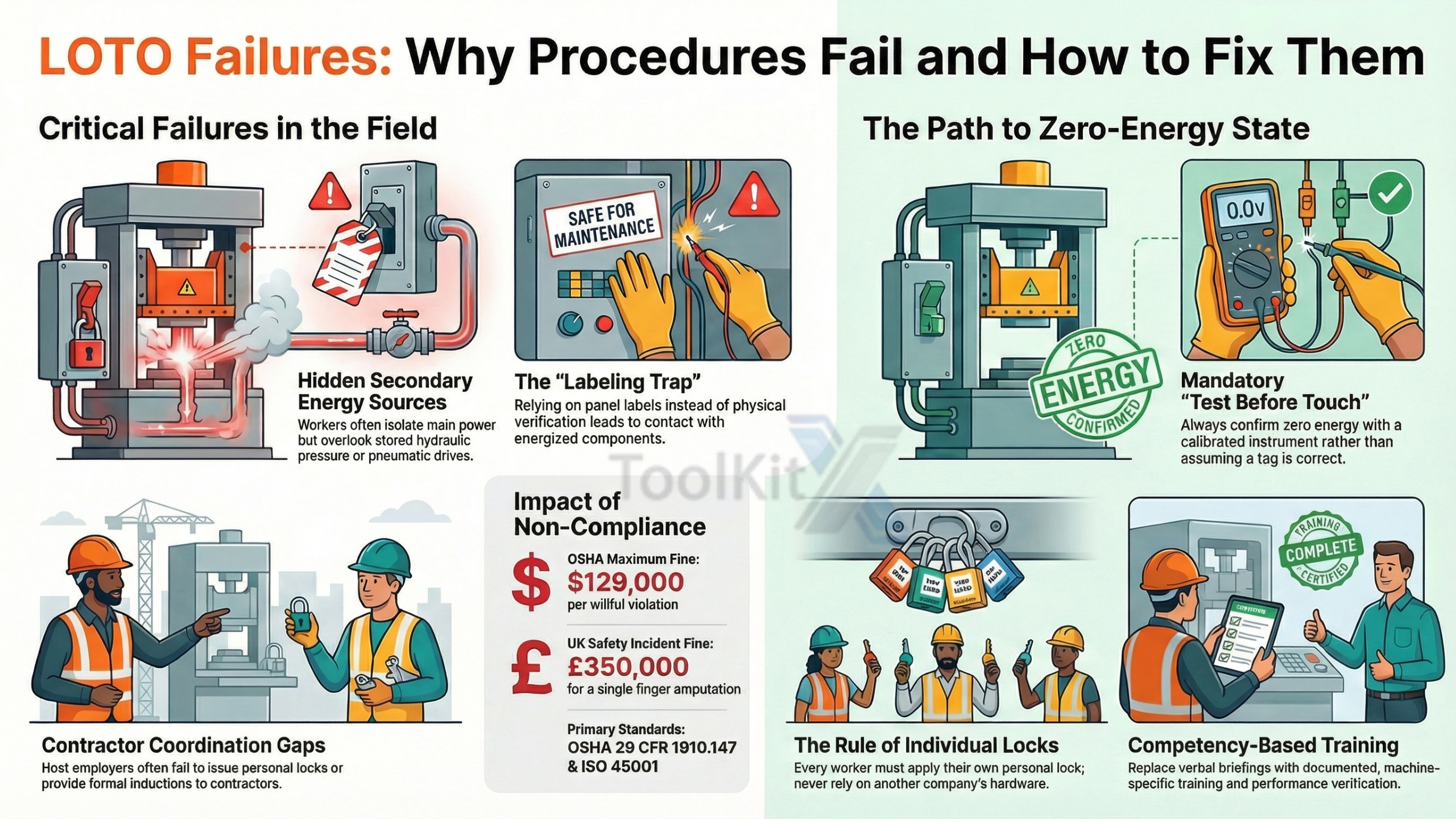
6 Real LOTO Failure Incidents
01) Food Processing
The Group Lock One Worker Never Applied
A cleaning crew used a group lockout box on a conveyor. One worker forgot to add their personal lock. A supervisor, believing the area was clear, removed the group lock and re energized the machine while that worker was still inside.
What went wrong
No individual verification that every worker had applied their personal lock before re energization. Verbal confirmation was substituted for a physical check.
Lesson
Every person must apply their own lock. A physical head count must precede any lock removal.
02) Power Generation
Mislabeled Panel "Test Before Touch" Skipped
An electrician locked out a panel based on its label. The panel had been mislabeled during an equipment upgrade months earlier. He skipped voltage verification and contacted an energized component, suffering a serious electric shock.
What went wrong
No "test before touch" step. The LOTO procedure assumed labeling was accurate rather than requiring independent energy verification.
Lesson
Zero energy state must always be confirmed with a calibrated instrument never assumed from a tag or label.
03) Oil & Gas / Petrochemical
Contractor Not Briefed - Machine Re Energized During Work
A refinery's internal LOTO procedure was correctly followed for its own team. A contractor crew working on the same system was never formally briefed and was not issued personal locks. A plant operator restored energy unaware the contractor was still in the isolated section. The contractor was seriously injured.
What went wrong
No formal contractor LOTO induction. No joint lock-out protocol. Communication gap between host employer and contractor supervision.
Lesson
Host employers are responsible for contractor LOTO compliance. Written induction, personal lock issuance, and joint verification are non-negotiable.
04) Automotive Manufacturing
Stored Hydraulic Energy Overlooked
A team replaced a hydraulic actuator on a stamping press. Electrical supply and hydraulic inlet were locked out. But a secondary hydraulic accumulator still charged at 2,000 PSI was absent from the LOTO procedure. When a technician loosened a fitting, the stored pressure released violently, injuring two workers.
What went wrong
Machine-specific LOTO procedure only addressed electrical isolation. The accumulator as a stored energy source was never identified or documented.
Lesson
Every LOTO procedure must address all energy forms. Partial isolation is not safe isolation.
05) UK Food Manufacturing
No Documented Training Finger Amputation, £350,000 Fine
A UK food manufacturer was fined over £350,000 by the Health and Safety Executive after an employee lost a finger maintaining packaging machinery. Workers received verbal briefings no structured LOTO training existed. The worker isolated the main power switch but did not know a secondary pneumatic drive remained energized.
What went wrong
No documented LOTO training. No competency verification. Secondary energy source not identified in any written procedure.
Lesson
LOTO training must be documented and machine specific. Verbal briefings do not meet regulatory requirements and do not prevent injuries.
06) Industrial / Switchgear Project
Backfeed Hazard Missed in Multi-Contractor Project
During a multi-contractor switchgear project, a bus tie breaker was returned to service mid job introducing a backfeed hazard where a worker was still cleaning. His Job Safety Analysis had been written before the energy status changed. Relying on other organizations' locks rather than applying his own, he contacted an energized section and suffered a severe electrical injury.
What went wrong
No real-time communication when energy isolation status changed. Worker relied on another company's locks. JSA was static, not updated when new hazards were introduced.
Lesson
Every worker must apply their own personal lock. Any change in energy status mid project must trigger formal re verification for all parties.
What These Incidents Have in Common
Across all seven cases, LOTO did not fail because people were unaware of the rules. It failed because the system around the rules was weak procedures incomplete, training informal, contractors uncoordinated, or verification skipped under time pressure. OSHA consistently identifies LOTO among the most cited standards, with willful violations carrying fines up to $129,000 per incident. The real cost, however, is always human.
Effective LOTO management means machine-specific written procedures, mandatory zero-energy verification, documented and competency-assessed training, formal contractor coordination, and field audits that go beyond paperwork. Organizations that treat LOTO as a living system not a one-time compliance exercise are the ones that avoid the incidents described above.
Organizations adopting digital platforms like ToolKitX gain better visibility into LOTO compliance across shifts, sites, and contractors connecting energy isolation procedures, Permits to Work, and compliance audits in a single operational view.